

Writing Your Own Dharmic Life Manifesto
Session 1 of the Peace & Sustainability Through Yoga Festival
What is it that you are going to dedicate your life to?
How will this dedication be a Dharmic dedication?
How does this relate to yoga?
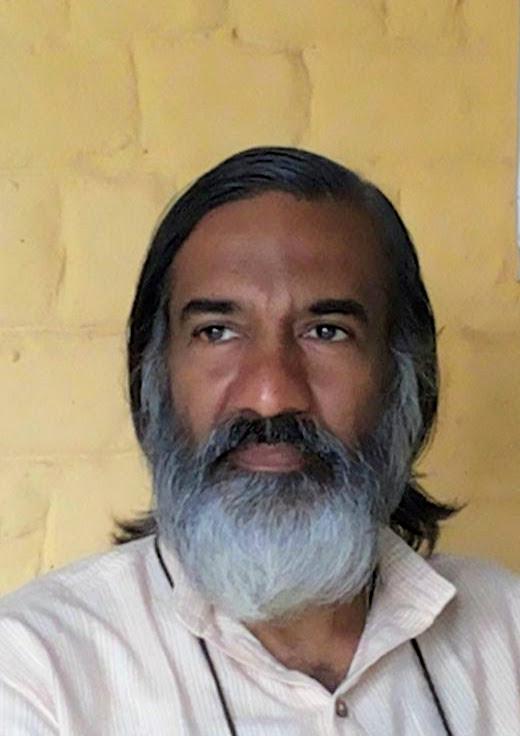
Sri Raghu Ananthanarayan (co-founder, Ritambhara) began the inaugural session of the recently concluded ‘Peace & Sustainability Through Yoga’ – 3 Days Online Yoga Festival with these questions to the participants. This online yoga festival was organised by Ritambhara in collaboration with India Foundation’s Center for Soft Power from June 18-20, 2020.
In this session Raghu spoke on the theme of the festival and building on the ideas mentioned in the Earth Manifesto that was shared at start of the festival which elaborated on the ideas of Peace, Responsibility and Dharma for the world. Extending this into an individual’s personal life, Raghu spoke about how one can start working with what one can call their own manifesto for life.
Raghu started his dialogue and shared his rich insights on the question “What is Dharma?” and explained the four principles from the Indian philosophy to understand Dharma. Some of the key ideas and themes from this session is shared below.
Yoga & Antaranga Yoga
Raghu started the session elaborating on the idea of Yoga and Antaranga Yoga by remembering an instance when a student once asked Sri TKV Desikachar a question, “Why is any philosophy important? Yoga is just asana and pranayama.”
Raghu explained why this is a fundamentally wrong question to ask. There are many Upanishadic references to yoga that do not mention asana and pranayama. One can be doing yoga even when one is not doing asana or pranayama. Similarly, one may not be experiencing yoga even in asana and pranayama if it is not done with a certain attentiveness and quality to it. So we need to remove a fundamental misunderstanding of equating asana and pranayama with yoga. He also shared how the concern for human sorrow is a fundamental aspect of yoga.
“Unless the teacher is really concerned about the dukkha of the universe, dukkha of the people around, and dukkha of the world, I will not trust yoga with this person.” – Sri TKV Desikachar
Raghu explained how āsana and prānāyāma are very obvious elements of yoga and have spread all of the world. However, Antaranga Yoga is an extremely important part of yoga which enables the mind to be capable of states of ekagrata and samadhi. The Peace & Sustainability Through Yoga online yoga festival focus on this aspect of Antaranga Yoga through the process of Swadhyāya.
Swādhyāya is to take critical ideas from scriptures, understand its depth, and live it. Shravanam is the listening to the words and really getting to the depth of the meaning of the words. Understanding the meaning of a word here is not the literal meaning, but an inner embodied understanding of the words through Mananam.
Dharmic Action – Kurukshetra vs Dharmakshetra
Raghu quoted an instance from Mahabharata when Arjuna enters into a deep dialogue with Sri Krishna (which can be seen as my own meditator self) at a time when all efforts for peace had failed and the war imminent. Arjuna asks the question to himself whether this is the right war to fight.
This dialogue and asking the question to oneself, “In Doing What I am Doing, What Am I Really Doing?” transforms one’s life from a Kurukshetra, i.e., a battle field that is self-centred and exhausting, into a Dharmakshetra, where each action that one does becomes part of a larger Dharmic effort.
At this point, Raghu explored the idea of what is a Dharmic action. Entire universe is grounded on Dharma. In my own life, I need to understand the meaning of Dharma, what is the ground I am standing on and how do I nourish this ground. Can I ask myself if every action I take is enlivening me, enlivening others, and enlivening the context that I am in?
Principles of Dharma:
- Astha – What is the truth that I am standing on? What is it that I believe about the world, about others and therefore my life? What do you wish to live for and how do you wish to live?
- Pratignya – The commitment to live in a certain way is based on your Astha – This is my dedication to life.
- Samskara – Your daily practice. A way of taking the energy of life and shaping it step by step – that is the practice of yoga. A real meditative practice will be – what is the truth of my life? What do I commit to? And practicing this.
- Moolyavan – The pursuit of this inner process will produce a fruit that gives one Ananda.
Raghu concluded that if you have to really work with humanness and live in peace with yourself and the world, the practice of yoga is the best approach. This was followed by a Q&A session.
The inaugural session was followed by an inner work through yoga exploration for the participants anchored by Ramya Iyengar from the Ritambhara team.
We reflected on what this means for each participant in their context of individual reality through introspecting on our idea of the world, the people and ourselves. Some questions that were explored during the self-reflective exercise were:-
- What is my ground of truth? Does this ground enliven me? Does it nourish me?
- Am I grounded in a Dharmic idea of the world, other people and yourself? Am I able to hold my ground in times of challenge?
- What ground of truth about the world, other people and myself will lead to peace and sustainability?
We then opened the session up for a contemplative conversation around this rooted in the insights shared by the participants. Some of the checkout words from the participants at the end of the session: Thoughtful, contemplative, playful, Joyous, Tapas, hopeful, inspiring, grateful.
You can watch the video of the full session here.
 Anoop is a student of Yoga, an entrepreneur, a coach and a father of two young boys. He has led successful leadership stints in both the corporate and non-for-profit sectors. On encountering the country’s water/farmer crises at close quarters, he decided to pause and examine the impact various ‘isms’ – capitalism, colonialism, etc., were having on us as individuals, families, the society and the environment at large. This quest led him to formally engage with traditional Indic knowledge systems while also learning from the latest advances in science – about our physical and mental wellbeing, importance of body and mind work in healing trauma and the urgent need for a conscious rebuilding of family / work / social structures if we have to thrive individually and collectively. Insights, frameworks and processes gleaned from these on-going studies, an anchorage in his own personal practice and his wide-ranging experiences is what Anoop brings to facilitation/coaching spaces in Ritambhara and his various professional engagements.
 Priya is a Yoga therapist in the Krishnamacharya tradition. She adapts Reiki & energy work, Vedic chanting, life coaching & Ayurvedic practices in her healing spaces. She is committed to nurturing collectives that have the praxis of Yoga at their heart.
 Anisha has been on an exploration to understand herself through yoga for the last 15years which led her to teaching yoga, yoga therapy and inner work through yoga.
 Apoorva chanced upon Yoga in her early 20s. A spark was lit within and there was no turning back. Her exploration led her to the Krishnamacharya tradition more than a decade ago. Curious about human behaviour and what drives it, she was thrilled when her search ended (and also began) when she first came upon the Yoga Sutra, which illuminated a path towards answering many questions that had been held for a long time.
 Anita is a yoga teacher and therapist in the tradition of Sri.T.Krishnamacarya and Sri T.K.V. Desikachar, a Reiki practitioner and a Life Coach. She is also the founder of Vishoka, a center for learning Indic and energy-based frameworks for living and healing. Her deep concern for human suffering and the problems of unsustainable living kept her on the path of seeking an integrated approach to looking at life, living, learning and healing.
 Ankit is a seeker in the wisdom traditions of India. The core of his work includes creating dialogic spaces where people can look within and see the connection between their inner and outer lives. Inspired by the likes of Gandhi, Aurobindo, Vivekananda and Guru Gobind his experiments in service took him back to his roots in Punjab where he is creating a community-led model of higher education which is open, inclusive and accessible for all. Ritambhara for him is a space for engaging in a community which is committed to a DHramic life. He anchors his work of learning and leadership in the Antaranga Yoga Sadhana and the humanistic wisdom of Mahabharata.