

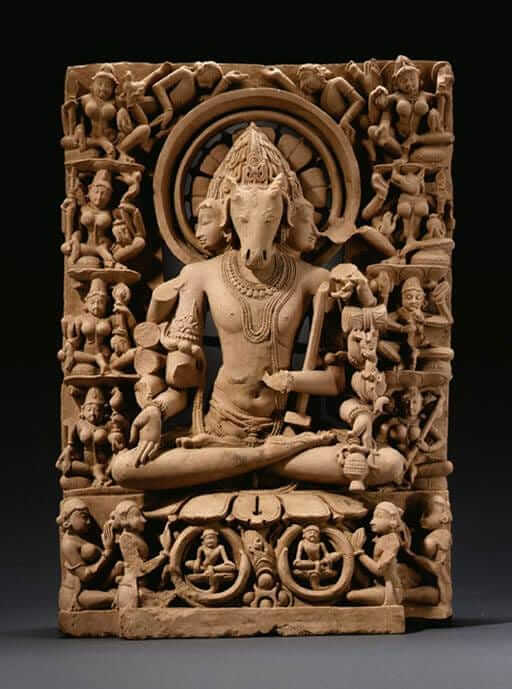
“We are being called idolators Acharya, please help me understand why we pray to idols?”
You should understand that you do not pray to idols. We use the temple and the deity in the temple as ways to evoke the sacred within us. The Temples are built in places of power and with a strict adherence to architectural principles and sacred geometry. The mūrti within them is sculpted to evoke a sense of beauty and order in us and with many symbols that remind us to live a dhārmika life. You become open to feeling the sacredness, the order and the beauty of the world when you go to the temple with devotion and absorb its energy.
Nirguṇa Brahman is pure Consciousness and has no form or attributes. You cannot realise what this means unless you are capable of deep levels of samādhi. You need practice to lead you from your present state to the possibility of experiencing the Divine. The entire universe emerges from Nirguṇa Brahman; therefore, every grain of sand and every blade of grass is replete with divinity and sacredness.
Be an āstika
In the Hindu tradition, we have had people called nāstika who have questioned the existence of Brahman. They say that the Brahman cannot be shown, so it does not exist. They even say that space cannot be accepted as one of the quintessential elements of matter because it cannot be seen or experienced by the senses like earthiness, fluidity, fieriness and airiness. Your question about idols sounds like the āstika — cārvāka idea. How do you know that a stone that you call jada vastu-non-living is different from a cow that you call ajada vastu– living?
“the cow has prāṇa.”
Can you see prāṇa? You cannot, but you know that there is an energy in the living object that is different from the non-living or the dead object. We call this prāṇa.
When I bring 100 stones, keep them in a heap, and count them, you and I will agree that there are 100 stones. The number 100 does not exist; you cannot hold, taste, see, or touch it, but both of us know the meaning of 100. We even have a way of speaking about it and doing arithmetic (gaṇita) with it. Without the idea of the number, can you build anything? So, be an āstika and have śraddhā — steadfast faith in what the Rishi’s have seen in samadhi.
The mūrti points to Brahman
The mūrti is only a pointer, like the number 100, that helps us go further in our sādhana— a journey towards realising the Nirguṇa Brahman. By making the avyakta and amūrta Brahman more tangible and vyakta through the mūrti– the Saguṇa Brahman (Brahman with name and form), the Hindus have built a bridge for us to walk on and realise the Divine within.
When you have to do a pūjā-worship at home, you pick up a bit of sandal powder or even some mud and make a kṣaṇika Ganapathy (temporary form of Ganesha). You invoke prāṇa into it by doing prāṇa pratiṣṭhā. You offer it flowers and other offerings. When you finish, you thank Lord Ganesha and say, “please return to where you came from”. The sculptural forms in the temple are exactly like that. A living Yogi is asked to do the prāṇa pratiṣṭhā in a temple. The temple priest keeps the energy alive through his Vedic rituals, and you go there to be blessed by the energy. Only fools think that name and form are pūrṇaṃ — whole. We have never given great importance to name and form.
 Anoop is a student of Yoga, an entrepreneur, a coach and a father of two young boys. He has led successful leadership stints in both the corporate and non-for-profit sectors. On encountering the country’s water/farmer crises at close quarters, he decided to pause and examine the impact various ‘isms’ – capitalism, colonialism, etc., were having on us as individuals, families, the society and the environment at large. This quest led him to formally engage with traditional Indic knowledge systems while also learning from the latest advances in science – about our physical and mental wellbeing, importance of body and mind work in healing trauma and the urgent need for a conscious rebuilding of family / work / social structures if we have to thrive individually and collectively. Insights, frameworks and processes gleaned from these on-going studies, an anchorage in his own personal practice and his wide-ranging experiences is what Anoop brings to facilitation/coaching spaces in Ritambhara and his various professional engagements.
 Priya is a Yoga therapist in the Krishnamacharya tradition. She adapts Reiki & energy work, Vedic chanting, life coaching & Ayurvedic practices in her healing spaces. She is committed to nurturing collectives that have the praxis of Yoga at their heart.
 Anisha has been on an exploration to understand herself through yoga for the last 15years which led her to teaching yoga, yoga therapy and inner work through yoga.
 Apoorva chanced upon Yoga in her early 20s. A spark was lit within and there was no turning back. Her exploration led her to the Krishnamacharya tradition more than a decade ago. Curious about human behaviour and what drives it, she was thrilled when her search ended (and also began) when she first came upon the Yoga Sutra, which illuminated a path towards answering many questions that had been held for a long time.
 Anita is a yoga teacher and therapist in the tradition of Sri.T.Krishnamacarya and Sri T.K.V. Desikachar, a Reiki practitioner and a Life Coach. She is also the founder of Vishoka, a center for learning Indic and energy-based frameworks for living and healing. Her deep concern for human suffering and the problems of unsustainable living kept her on the path of seeking an integrated approach to looking at life, living, learning and healing.
 Ankit is a seeker in the wisdom traditions of India. The core of his work includes creating dialogic spaces where people can look within and see the connection between their inner and outer lives. Inspired by the likes of Gandhi, Aurobindo, Vivekananda and Guru Gobind his experiments in service took him back to his roots in Punjab where he is creating a community-led model of higher education which is open, inclusive and accessible for all. Ritambhara for him is a space for engaging in a community which is committed to a DHramic life. He anchors his work of learning and leadership in the Antaranga Yoga Sadhana and the humanistic wisdom of Mahabharata.