

A gist of a discourse on chanting by Yogacharya Krishnamacharya:
Many of you grew up in households where some mantras whether Suprabhaṭām or Bhaja Govindam played in the background or someone who had deep faith in Hanuman, chanted the Hanuman Chālisa silently or chanted it loudly so that the entire home was filled with those vibrations. This is done so that you are exposed to the power of sound. But more than listening passively you must use your voice to heal yourself and progress in life.
Chanting in yoga sādhana.
Why is chanting an important part of yoga sādhana? The focus of yoga abhyāsa is tapas. Why is tapas the starting point? Most people have a conditioned mind, so our responses and views of the world are also conditioned which comes from a space of strong compulsive energy (abhinivesha). These actions cause disturbances or duḥkha. Only when one has a grasp of my inner processes and makes meaningful choices will one be able to go beyond duḥkha. Tapas is the process through which one ripens or purifies the mind and body, to dissolve these compulsive responses.
Using agni — the fire in the body
Ripening is through the heat that is there in our body. There are three types of fire- dhyāna agni the fire of an insightful mind, jaṭharāgni — the digestive fire and deha agni — the heat in the body. If the fire is subdued or over-emphasized, ripening cannot take place. There are many practices in Yoga to tend this fire in the right way so that the seeds of the saṃskāra-s can be burnt.
Vāk (speech) is agni in the manifest form. It rises with the prāṇa agni — the fire inherent in one’s life energy, to become one with dhyāna agni in one’s mind. Chanting is a way to travel back to the source. When you chant and listen intently to the sound of the chanting, you will become aware of how the sound is produced in your body and how the breath is controlled. This balances the jAThara agni and dEha agni. When you can observe how the sound arises in your mind, you start the journey of awakening dhyAna agni.
Chanting and prāṇa nādi
There are prāṇa nādi-s within our body, which are energy channels. Chanting done correctly helps cleanse the channels to streamline the flow of energy because they vibrate the nādi-s. At this level, you may not understand the meaning of the chants, but they affect you. Thus, the choice of chant is the basis of your specific need. E.g. years ago, I had a young student who practised chanting the agni bīja mantra with virabhadrāsana. He liked the feeling and overdid the practiceand after a few weeks, he developed red eyes and boils and experienced irritability. All of this happened because the heating process became excessive.
Chanting with meaning
When you add meaning and understand the object referred to in the chant your mind becomes more subtle. E.g. When you chant the gāyatri mantra, bring your focus to the rising sun. This will enhance the experience and the effect of the chant. The yogic theory says that the object of your attention affects your psyche. In this case, the morning sun is the purest form of nature and the energy of rays can help dissolve the inner blocks. Care must be taken to choose the devatā of the mantra that is right for you.
Going even deeper
The third level is when you pay attention to the origin of the sound and energies of the Prakṛti that generates the sound. This means that your mind is becoming subtle, and acts from silence. It can therefore observe the origin of the sound from silence. When you stay in this deep state, you start identifying with Puruṣa and Prakṛti. This has been described in great detail in the Shiva sutras. Mātṛā refers to the vibration of the letter. Prakṛti is composed of the energy of satvam, rajas and tamas. These three interact in certain ratios, proportions and rhythms. This interaction is the basis of manifestation. Chanting helps one to harmonise the mind with this fundamental pattern.
Some shlokas describe the beauty and power of the divine. Vishnu sahasranāmam focuses on the myriad aspects of the one Vishnu. There are similar śloka on Devi and Shiva. There are bīja mantra-s that awaken psychic energies. Each has a different effect. Bīja mantra-s and Veda mantra-s emanate from the praṇava mantra or OM. Thus, their sound is the same as their visual or energy form and is integrated and balanced. Regular chanting while listening carefully and observing yourself will help you discover the form that is implicitly held in the sound.
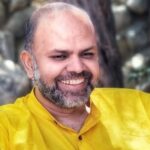 Anoop is a student of Yoga, an entrepreneur, a coach and a father of two young boys. He has led successful leadership stints in both the corporate and non-for-profit sectors. On encountering the country’s water/farmer crises at close quarters, he decided to pause and examine the impact various ‘isms’ – capitalism, colonialism, etc., were having on us as individuals, families, the society and the environment at large. This quest led him to formally engage with traditional Indic knowledge systems while also learning from the latest advances in science – about our physical and mental wellbeing, importance of body and mind work in healing trauma and the urgent need for a conscious rebuilding of family / work / social structures if we have to thrive individually and collectively. Insights, frameworks and processes gleaned from these on-going studies, an anchorage in his own personal practice and his wide-ranging experiences is what Anoop brings to facilitation/coaching spaces in Ritambhara and his various professional engagements.
 Priya is a Yoga therapist in the Krishnamacharya tradition. She adapts Reiki & energy work, Vedic chanting, life coaching & Ayurvedic practices in her healing spaces. She is committed to nurturing collectives that have the praxis of Yoga at their heart.
 Anisha has been on an exploration to understand herself through yoga for the last 15years which led her to teaching yoga, yoga therapy and inner work through yoga.
 Apoorva chanced upon Yoga in her early 20s. A spark was lit within and there was no turning back. Her exploration led her to the Krishnamacharya tradition more than a decade ago. Curious about human behaviour and what drives it, she was thrilled when her search ended (and also began) when she first came upon the Yoga Sutra, which illuminated a path towards answering many questions that had been held for a long time.
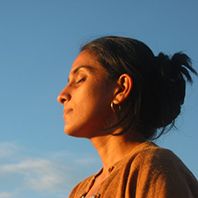 Anita is a yoga teacher and therapist in the tradition of Sri.T.Krishnamacarya and Sri T.K.V. Desikachar, a Reiki practitioner and a Life Coach. She is also the founder of Vishoka, a center for learning Indic and energy-based frameworks for living and healing. Her deep concern for human suffering and the problems of unsustainable living kept her on the path of seeking an integrated approach to looking at life, living, learning and healing.
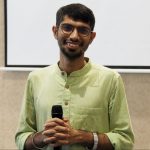 Ankit is a seeker in the wisdom traditions of India. The core of his work includes creating dialogic spaces where people can look within and see the connection between their inner and outer lives. Inspired by the likes of Gandhi, Aurobindo, Vivekananda and Guru Gobind his experiments in service took him back to his roots in Punjab where he is creating a community-led model of higher education which is open, inclusive and accessible for all. Ritambhara for him is a space for engaging in a community which is committed to a DHramic life. He anchors his work of learning and leadership in the Antaranga Yoga Sadhana and the humanistic wisdom of Mahabharata.