

Your children are not your children.
They are the sons and daughters of Life’s longing for itself.
They come through you but not from you,
And though they are with you
yet they belong not to you
-Kahlil Gibran
Kahlil Gibran really set the stage for us to think of our relationship with our children and our parents, at the Parenting Inside Out retreat, last December. It resonated with the way the Indian tradition, and perhaps other ancient traditions/texts, view the relationship between children and parents. As a facilitator, a parent, and a daughter, I am sharing here a few things that emerged for me, out of this retreat.
Our parents are not responsible for how we have chosen to respond to the evocations and provocations we have received from them.
This is a statement made by Raghu often, and I think this can never be stated often enough! Taking this one step forward, our children will take and make what they make of what we offer them (the evocations and provocations). While that does not absolve us from trying to be the best we can be in our role as parents, it also means much as we try, there will be goof-ups :).
There is no such thing as perfect parenting :). All we can do is to own up and take responsibility for our goof-ups, and hopefully our children/parents own up and take responsibility for theirs.
What retreats/workshops like this offer are contemplative spaces, to move away from our habitual patterns, to move into prati-aharam (pratyaharam), to listen/see/experience more deeply the entire landscape of parenting.
The retreat does not profess to to fix any patterns through interventions, or offer any specific/generic solutions. What it does is offer frameworks through which to see our lives, role identities, thoughts, actions, and behavior. Perhaps out of this seeing, some clarity on the next step emerges for each one of us in, and through, the collective space that we hold.
At every stage of the child’s growth development there are different needs, boundaries, challenges, ways to hold/guide the child and so on.
While I have chanted the Bhriguvalli several times, this time chanting it at the retreat brought my attention to how Varuna, Bhrigu’s father responds to his questions.
Varuna, who is a very knowledgeable sage, does not dump the knowledge onto his son. Instead, he asks him to meditate, and find the answer out for himself.
What an appropriate response – guiding his son to be a true seeker at an age when he is ready to begin seeking. Not holding on, not protecting, not judging and not distracting. A response without any attachment to whether his son will be able to find the answer or not, a response that places trust in the process and not the outcome. I asked myself: to what extent am I as a parent attached to the outcome and not placing my trust/effort in the process!
When looking at ourselves as parents, we also have to remember the intergenerational context – that we are children of our parents, who are children of their parents and so on, and that there is perhaps a collective psyche of the intergenerational family context that I belong to.
And as we keep the questions of who am I, where am I, and why am I here, alive as often as possible, we might touch deeper spaces individually and collectively, discovering what to do next for our children, the nation, the earth that we belong to – across space-time boundaries.
Another area of work is to see what part of our own, our parents’ and our children’s emotional life are we unable to respond to from a space of inner quietude, and therefore block out by shutting down/freezing, judging, distracting and/or protecting them.
For myself, I have been afraid to touch my mom’s pain/hurt. The usual response is – she needs to know how to get over it (judge/wise person), she needs to have the strength to get over it (guardian/warrior), she needs to find other things to do and engage herself (beckoner/seeker).
While these may be valid responses, the question of where this is coming from is crucial to observe. Is the response coming from a reactionary, obsessive, compulsive, uncomfortable space, or is it coming from an alive, vibrant, all-encompassing quiet space.
For me now, it is no longer about any of these responses, but to find the inner space within me to be with her pain and respond as it guides/directs.
I have also begun to see that the role and context of parenting is very evocative and central in my life at the moment.

Every time I attend a program at Ritambhara, I delve deeper into the meanings of much of what I think I have understood. When I bring it back into the context of parenting and the retreat that is offered twice a year, I see and understand much more. It is the cycle of sravanam, grahanam, mananam, nidhidyasanam for me.
And finally to hold all of this lightly; to laugh, smile, and cry at the miracle this world is (including each one of us) – with all its beauty, ugliness, frightful things, and much more.
 Anoop is a student of Yoga, an entrepreneur, a coach and a father of two young boys. He has led successful leadership stints in both the corporate and non-for-profit sectors. On encountering the country’s water/farmer crises at close quarters, he decided to pause and examine the impact various ‘isms’ – capitalism, colonialism, etc., were having on us as individuals, families, the society and the environment at large. This quest led him to formally engage with traditional Indic knowledge systems while also learning from the latest advances in science – about our physical and mental wellbeing, importance of body and mind work in healing trauma and the urgent need for a conscious rebuilding of family / work / social structures if we have to thrive individually and collectively. Insights, frameworks and processes gleaned from these on-going studies, an anchorage in his own personal practice and his wide-ranging experiences is what Anoop brings to facilitation/coaching spaces in Ritambhara and his various professional engagements.
 Priya is a Yoga therapist in the Krishnamacharya tradition. She adapts Reiki & energy work, Vedic chanting, life coaching & Ayurvedic practices in her healing spaces. She is committed to nurturing collectives that have the praxis of Yoga at their heart.
 Anisha has been on an exploration to understand herself through yoga for the last 15years which led her to teaching yoga, yoga therapy and inner work through yoga.
 Apoorva chanced upon Yoga in her early 20s. A spark was lit within and there was no turning back. Her exploration led her to the Krishnamacharya tradition more than a decade ago. Curious about human behaviour and what drives it, she was thrilled when her search ended (and also began) when she first came upon the Yoga Sutra, which illuminated a path towards answering many questions that had been held for a long time.
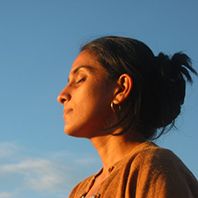 Anita is a yoga teacher and therapist in the tradition of Sri.T.Krishnamacarya and Sri T.K.V. Desikachar, a Reiki practitioner and a Life Coach. She is also the founder of Vishoka, a center for learning Indic and energy-based frameworks for living and healing. Her deep concern for human suffering and the problems of unsustainable living kept her on the path of seeking an integrated approach to looking at life, living, learning and healing.
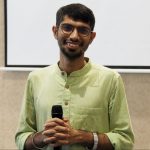 Ankit is a seeker in the wisdom traditions of India. The core of his work includes creating dialogic spaces where people can look within and see the connection between their inner and outer lives. Inspired by the likes of Gandhi, Aurobindo, Vivekananda and Guru Gobind his experiments in service took him back to his roots in Punjab where he is creating a community-led model of higher education which is open, inclusive and accessible for all. Ritambhara for him is a space for engaging in a community which is committed to a DHramic life. He anchors his work of learning and leadership in the Antaranga Yoga Sadhana and the humanistic wisdom of Mahabharata.