

How does one live a life where one can act with honour and live in peace?
Never before has the past been less reliable for steering oneself into a meaningful future. How can a person re-envision oneself in response to a radically changing world?
All of us are confronted with questions like this. We turn to various traditions, their wisdom and practices. SaptaSwara is a unique programme, designed by Sashikala & Raghu Ananthanarayanan, that allows the participant to discover a personal practice that will help the individual act with honour, live in peace and grow inwardly.
SaptaSwara offers the following :
- A ‘here and now’ encounter with oneself
- A contemplative context for self reflection
- An experiential learning about the insights of Yoga
- A framework for developing an enduring personal practice.
In this context 7 critical concepts/ principles from the tradition are explored in depth to empower the self and to unfold the slumbering potential that lies within the person.
The seven steps are:
- Maitri- friendliness,
- Karma- action,
- Dharma- enlivening self and context,
- Gnyana- knowledge,
- Ramya- aesthetics or inner savouring,
- Yoga- personal practice, and
- Abhyasa- long term investment in growth.
The process of this module is to help the individual to look at the self, one’s relationships and one’s actions in a seamless continuity. In achieving a personal balance and centring of the various aspects of oneself, one also becomes capable of relating with greater authenticity with the world around and to act with greater clarity and integrity in one’s everyday life.
This module has been adapted for various groups, organisations and institutions. The process involves the building of a conducive environment where the individual can explore the many aspects of the self and it’s application in the world of action.
In June of 2017, a group of Montessori teachers and trainers completed a SaptaSwara retreat. The retreat was a second level to help the individuals consolidate their learning and to create more meaningful links with each other and with their parent institution.
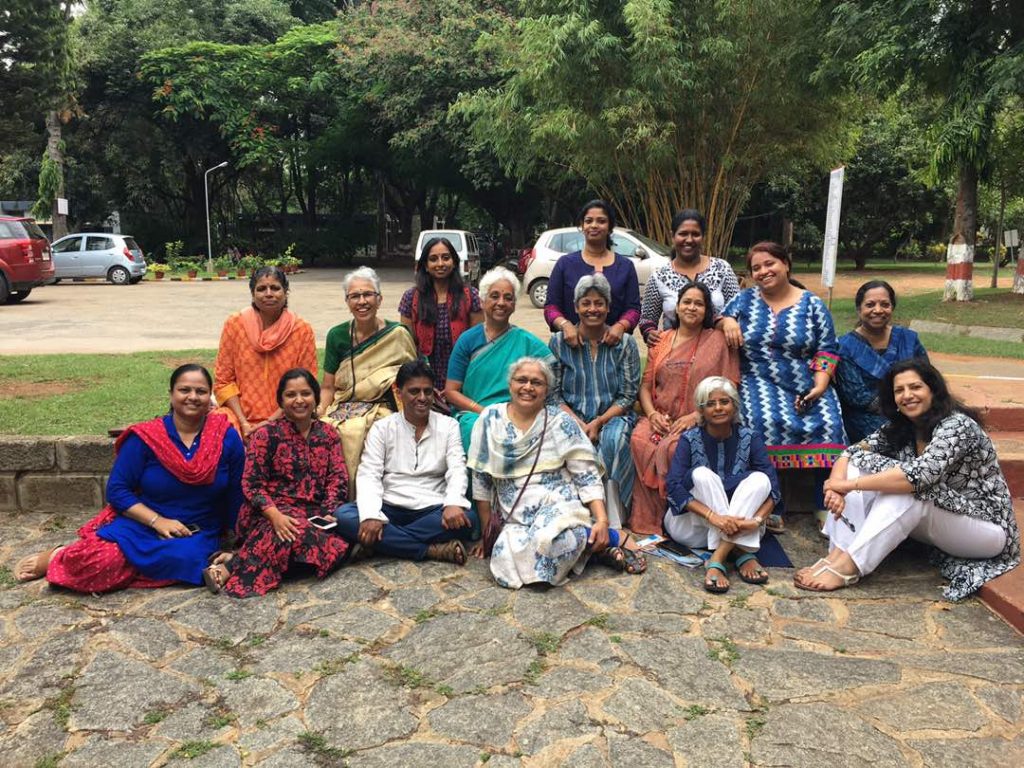
Three specific methods were followed for the two day retreat.
The first was pictorial representation of the personal journey, which was then shared within small groups. When the hand draws without getting caught up in thought, there is a flow of intuitive responses and emotions. The individual is then able to access deep level cleansing, healing, and catharsis.
The second method was meditation on the seven steps, and the individual’s experience of them as well as their impact on relationships.
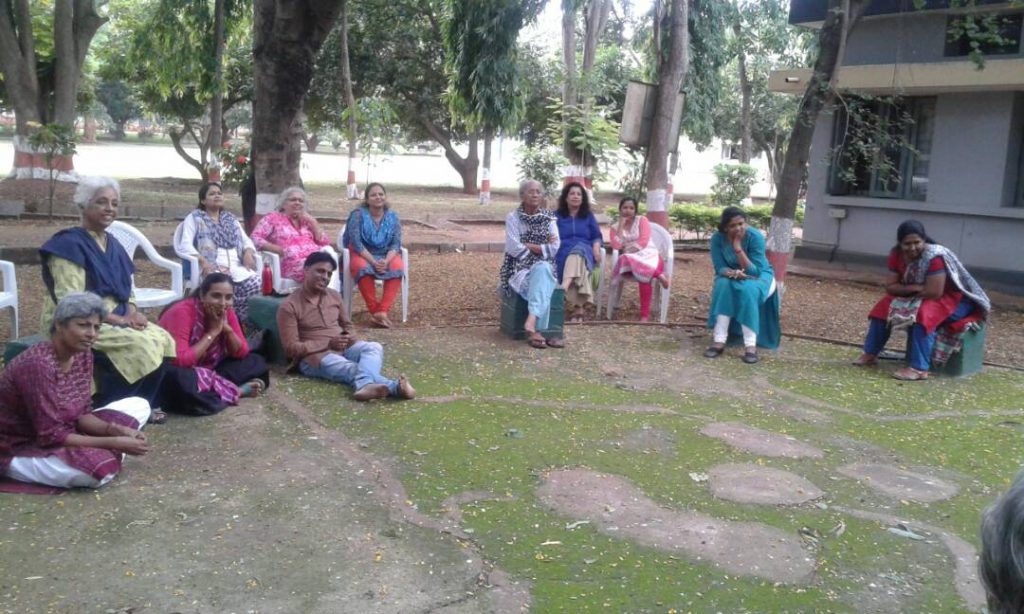
The third method we used was to enact the various role interactions in the organisations and to re play possible variations that are available, so that repertoires could be enlarged and transformed. Each of us feels and responds inwardly, but it is only through relationships that we engage with the outward form and active experimentation of our inner potential. Frequently this engagement gets stuck in entrenched forms. Role play helps to unlock these blocks and offers us new ways to activate ourselves without fear and anxiety about the outcome. We are able to stretch our repertoire, and so add to our capabilities
The participants felt very enriched and inspired at the end of the two days. Many of them felt rejuvenated and expressed a desire to experience this module every year so that the institution could be constantly renewed.
 Anoop is a student of Yoga, an entrepreneur, a coach and a father of two young boys. He has led successful leadership stints in both the corporate and non-for-profit sectors. On encountering the country’s water/farmer crises at close quarters, he decided to pause and examine the impact various ‘isms’ – capitalism, colonialism, etc., were having on us as individuals, families, the society and the environment at large. This quest led him to formally engage with traditional Indic knowledge systems while also learning from the latest advances in science – about our physical and mental wellbeing, importance of body and mind work in healing trauma and the urgent need for a conscious rebuilding of family / work / social structures if we have to thrive individually and collectively. Insights, frameworks and processes gleaned from these on-going studies, an anchorage in his own personal practice and his wide-ranging experiences is what Anoop brings to facilitation/coaching spaces in Ritambhara and his various professional engagements.
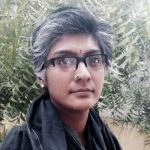 Priya is a Yoga therapist in the Krishnamacharya tradition. She adapts Reiki & energy work, Vedic chanting, life coaching & Ayurvedic practices in her healing spaces. She is committed to nurturing collectives that have the praxis of Yoga at their heart.
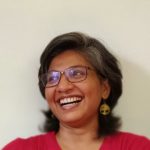 Anisha has been on an exploration to understand herself through yoga for the last 15years which led her to teaching yoga, yoga therapy and inner work through yoga.
 Apoorva chanced upon Yoga in her early 20s. A spark was lit within and there was no turning back. Her exploration led her to the Krishnamacharya tradition more than a decade ago. Curious about human behaviour and what drives it, she was thrilled when her search ended (and also began) when she first came upon the Yoga Sutra, which illuminated a path towards answering many questions that had been held for a long time.
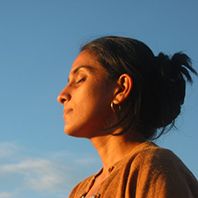 Anita is a yoga teacher and therapist in the tradition of Sri.T.Krishnamacarya and Sri T.K.V. Desikachar, a Reiki practitioner and a Life Coach. She is also the founder of Vishoka, a center for learning Indic and energy-based frameworks for living and healing. Her deep concern for human suffering and the problems of unsustainable living kept her on the path of seeking an integrated approach to looking at life, living, learning and healing.
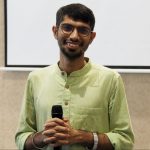 Ankit is a seeker in the wisdom traditions of India. The core of his work includes creating dialogic spaces where people can look within and see the connection between their inner and outer lives. Inspired by the likes of Gandhi, Aurobindo, Vivekananda and Guru Gobind his experiments in service took him back to his roots in Punjab where he is creating a community-led model of higher education which is open, inclusive and accessible for all. Ritambhara for him is a space for engaging in a community which is committed to a DHramic life. He anchors his work of learning and leadership in the Antaranga Yoga Sadhana and the humanistic wisdom of Mahabharata.