

I recently offered a one day version of the Parenting Inside Out program at a school, where parents and teacher participated in the exploration of what it means to be a parent and a teacher. The program is based on the approach that is the basis of our work at Ritambhara, which has evolved by integrating yoga (as a philosophy, process and practice), texts from the Indian tradition mainly the Itihasa Purana, and Upanishad, theater, and process work.
After an initial introduction to the framework of yoga and the approach for the session, we got into exploring some parent-child contexts from stories from Itihasa Purana. Participants were given 4 triads to choose from and enact a short scene of about 3-5 min from a story that has this triad.
The triads were –
- Dasaratha, Kaikeyi and Rama,
- Shantanu-Satyavati-Bheeshma,
- Dronacharya-Ekalavya-Arjuna and
- Dhritarashtra-Gandhari-Duryodhana.
After each enactment, we shared what was evoked within us, as audience as well as actors.
Meeting The Actor Within
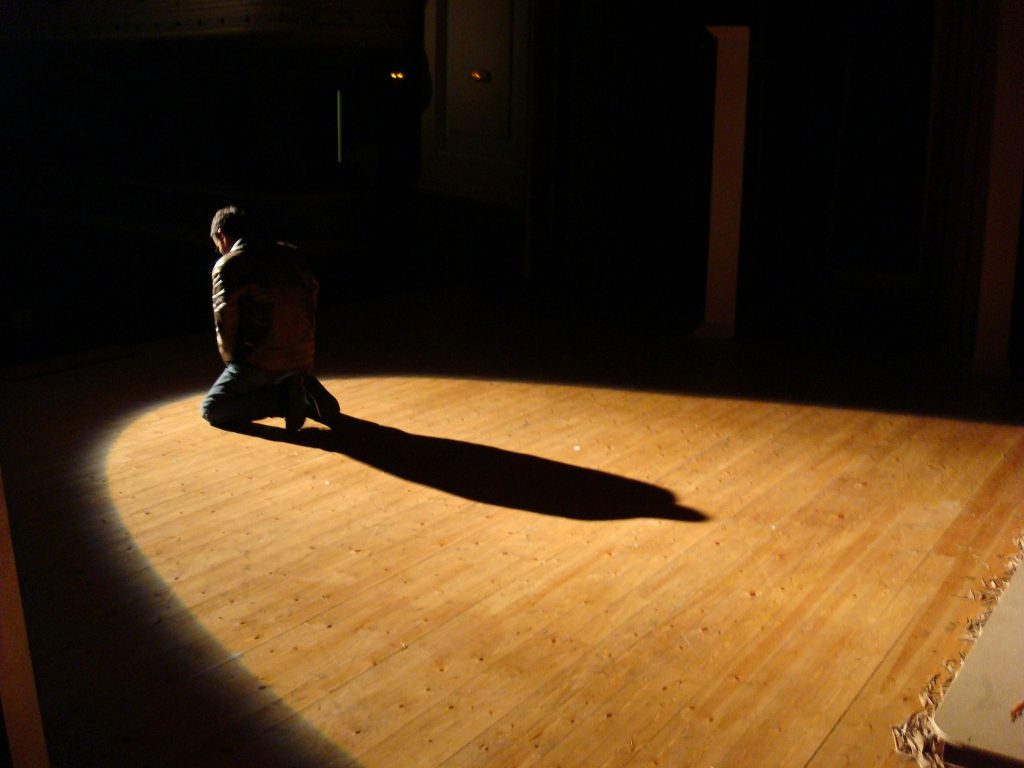
Each person got in touch with something deep from within themselves. This was a reflection of their inner world, as it met the outer scene being enacted or the role they took up in that act. Those who were initially hesitant, said that the experience of acting got them in touch with the way they connected or could not connect to the character that they played. It also helped them see the character more personally, from the inside out rather than as an external role/character.
Many shared statements from their role/personal context:
“I can connect to the part in me that is like Kaikeyi, to use the opportunity to steer things the way I want”
“I feel the burden of being privileged, knowing what many others have given up or do to be/keep me where I am,”
“I felt the struggle within me for my longing and desires for myself and my child,”
“I feel the heaviness of being an obedient son or daughter,” and many many more.
At the end of the program, I asked participants to share a statement on what they were taking back with them.
Some of the statements included
- To learn to stay with my problem without feeling helpless and to create space for it instead of being consumed by it
- Ponder on the question of what is my idea of an ideal parent or child?
- To be aware of my rush to find solutions
- To learn to take responsibility for my actions, own up to my fears and desires
- To recognize that there is a lot for me to learn and pass to my child from my tradition
As a facilitator a few things that emerged/got clarified for me were
1. The re-affirmation in the power of this approach in bringing to the fore the tensions that people experience with respect to their role-identity and not giving instant solutions. My sraddha in this approach and my committment to study and learn further in this approach continues to deepen.

Too long I have searched for solutions, not just outside of me, but outside of what texts like the Itihasa purana, Yoga sutra, Upanishads have to offer. Conscious parenting, unconditional parenting, authentic parenting etc. are wonderful adjectives of a manifestation, but the question of the internal process remains.
And this is where I find that the process of yoga has become my anchor. The way ahead, the path, and the direction to continue has become not only clear but well-established for me.
2. The re-affirmaton for doing programs on the theme of parenthood. There is an urgent need to create communities/spaces where parents can come to reflect and share in a meditative, reflective and transformative way.

We need spaces where solutions are not offered by experts, where one begins to see who I am in this role as a parent and then begins to identify solutions for oneself.
Too often skills, suggestions and advice to parents is based on externalities without considering the entire internal milieu of a person (hetu-phala-ashraya-alambana is a phrase that comes to mind from the yoga sutra – I could say a lot more, but that will be for another post).
3. The story of Dhritarashtra-Gandhari-Duryodhana was not picked up by any group. It seems to me to reflect something about us as a collective in today’s world.

To be in the position of a Dhritarashtra and Gandhari would mean that we need to encounter the part of us that has been blinded or has failed as parents in our role and responsibility, and that is certainly not very easy to do.
It would mean that we own up to our compulsions and desires and see how we have transferred it to the next generation. It is a tall order indeed!
The Underlying Questions of Our Age
- What are my blindspots as a parent, as a child?
- In doing whatever I am doing as a parent, am I passing on my wishes and desires to my child and hoping that my child strives and lives up to those?
- In doing what I am doing as a son or daughter, am I caught in and living my parents’ dreams, wishes and desires?
Our children will be bearing the burden of all our fears, desires, compulsions especially at the environmental and ecological plane. Do we have the wherewithal to step into this scene, listen to it and change the course of the events, everyday, every moment? There is no place for blame either if we want to take responsibility for all that has been done from the previous generation. As children of our parents, we must own up to our responsibility and decision to be in this world at this moment in the life of this universe. Will we continue to be Duryodhana, or change the course of action?
I am convinced that this cannot be done without yoga (as a philosophy, practice and process). I am not suggesting this as a pill for solving all problems, but rather that taking this step and staying on this enquiry requires tremendous sraddha, virya and smrti (again from the yoga sutra) for which one needs to be guided/energized by and established in some philosophy, process and practice that is integrated (at multiple levels), and at the moment I know of nothing else other than yoga that would enable us to do so.
If you are ready to take responsibility, own up, and take a step on this path, join us at the next Parenting Inside Out, one of the programs offered by Ritambhara. If you would like to help organise such a program for your community, contact us at ashram@ritambhara.org.
 Anoop is a student of Yoga, an entrepreneur, a coach and a father of two young boys. He has led successful leadership stints in both the corporate and non-for-profit sectors. On encountering the country’s water/farmer crises at close quarters, he decided to pause and examine the impact various ‘isms’ – capitalism, colonialism, etc., were having on us as individuals, families, the society and the environment at large. This quest led him to formally engage with traditional Indic knowledge systems while also learning from the latest advances in science – about our physical and mental wellbeing, importance of body and mind work in healing trauma and the urgent need for a conscious rebuilding of family / work / social structures if we have to thrive individually and collectively. Insights, frameworks and processes gleaned from these on-going studies, an anchorage in his own personal practice and his wide-ranging experiences is what Anoop brings to facilitation/coaching spaces in Ritambhara and his various professional engagements.
 Priya is a Yoga therapist in the Krishnamacharya tradition. She adapts Reiki & energy work, Vedic chanting, life coaching & Ayurvedic practices in her healing spaces. She is committed to nurturing collectives that have the praxis of Yoga at their heart.
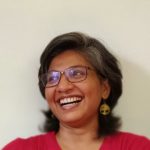 Anisha has been on an exploration to understand herself through yoga for the last 15years which led her to teaching yoga, yoga therapy and inner work through yoga.
 Apoorva chanced upon Yoga in her early 20s. A spark was lit within and there was no turning back. Her exploration led her to the Krishnamacharya tradition more than a decade ago. Curious about human behaviour and what drives it, she was thrilled when her search ended (and also began) when she first came upon the Yoga Sutra, which illuminated a path towards answering many questions that had been held for a long time.
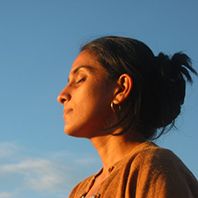 Anita is a yoga teacher and therapist in the tradition of Sri.T.Krishnamacarya and Sri T.K.V. Desikachar, a Reiki practitioner and a Life Coach. She is also the founder of Vishoka, a center for learning Indic and energy-based frameworks for living and healing. Her deep concern for human suffering and the problems of unsustainable living kept her on the path of seeking an integrated approach to looking at life, living, learning and healing.
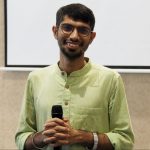 Ankit is a seeker in the wisdom traditions of India. The core of his work includes creating dialogic spaces where people can look within and see the connection between their inner and outer lives. Inspired by the likes of Gandhi, Aurobindo, Vivekananda and Guru Gobind his experiments in service took him back to his roots in Punjab where he is creating a community-led model of higher education which is open, inclusive and accessible for all. Ritambhara for him is a space for engaging in a community which is committed to a DHramic life. He anchors his work of learning and leadership in the Antaranga Yoga Sadhana and the humanistic wisdom of Mahabharata.