

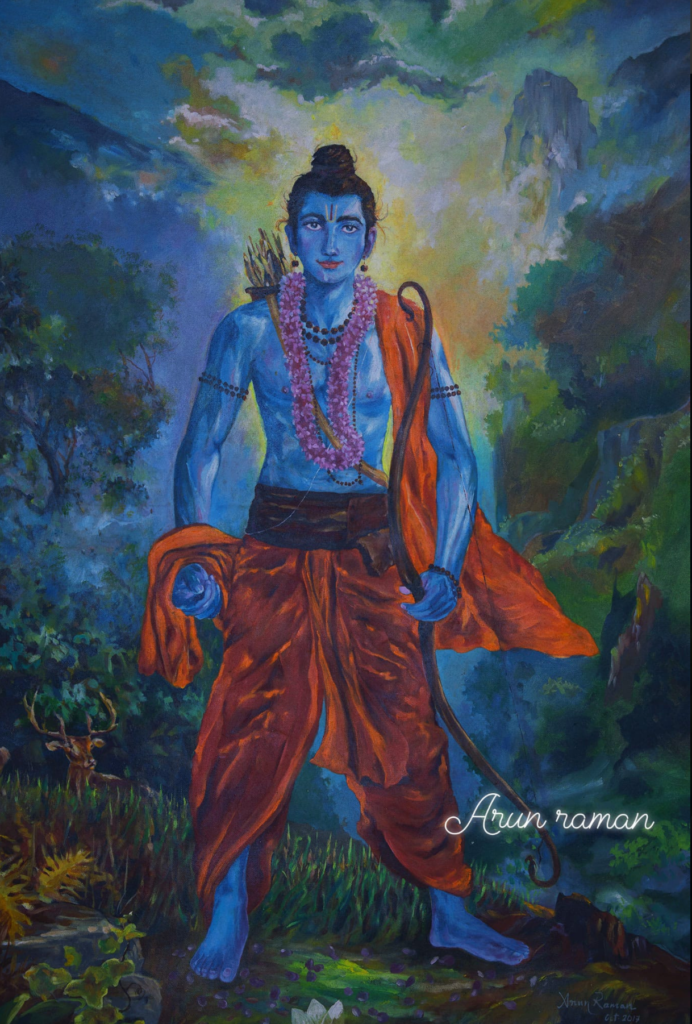
Growing up in Kerala, this time of year brings back nostalgic memories of beautiful yet ceaseless rains of the monsoon (idavapāthi) that almost always coincide with the school reopening on June 1, as well as the start of the Rāmāyaṇa Māsam when most Hindu households engage in the daily recital of Rāmāyaṇa in their households. Rāmāyaṇa Māsam is celebrated during the Karkidaka month (July 17 – August 16). Per Malayalam calendar, this phase marks the transition of Sun from the karkidaka rāśi to the mithuna rāśi, giving this month its name in Kerala calendar system. This year, I feel fortunate that I have got the opportunity for an antaraṇgasādhana on Rāmāyaṇa during this time through the Rāmāyaṇa Exploration Online (REO)* along with 22 co-travellers from around the world. Each week we look at the stories from Rāmāyaṇa from a self-reflective space seeking to discover the Rāma space – one filled with ramyam (beauty) – within.
Some very critical questions about self and one’s relationship with the systems around came alive in the past week’s exploration.
- Ideas of Perfection – Rāmā’s descriptions and actions evoked different ideas and associations of perfection for many of us. While for some it was aspirational, for many it also brought out the burden of meeting certain benchmarks one has created/accepted in their minds. Whose ideas of perfection have I imbibed and made my own? What is it in me that is making want to achieve perfection the moment I see it outside of me? Can one experience dukkha (sorrow) even when everything else is ‘perfect’?
- Engaging with One’s Fears – The attitude of Rāma and Lakshmaṇa while fighting with Tātaka brought out rich evocations around engaging with one’s fears. For some, it opened up the possibility of engaging with what is ugly and frightening in life from a space of lightness. For others, it brought to the fore questions about the impact of socialisation on the identity and actions of children. The sense of betrayal that our younger selves have experienced when the elders in our lives let us down in moments when we needed their counsel also came alive for exploration.
- Discovering One’s Place in the World – Rāma taking centre stage in the initial stories also mirrored questions around Lakshmana’s role and importance for some in the group. We reflected upon what does it feel like when I take my place in the world? How much of this place is in comparison with others around me? When I feel I am in someone’s shadows, how does it make me feel? What does it really mean to me?
For myself, this journey is bringing up questions that are letting me get a glimpse of the space of Rāma within and the impediments that are challenging me to access and experience this space within me.
*REO is a flagship offering of Ritambhara Ashram and the current cohort is facilitated by Hariprasad Varma and Ajay Viswanath.
 Anoop is a student of Yoga, an entrepreneur, a coach and a father of two young boys. He has led successful leadership stints in both the corporate and non-for-profit sectors. On encountering the country’s water/farmer crises at close quarters, he decided to pause and examine the impact various ‘isms’ – capitalism, colonialism, etc., were having on us as individuals, families, the society and the environment at large. This quest led him to formally engage with traditional Indic knowledge systems while also learning from the latest advances in science – about our physical and mental wellbeing, importance of body and mind work in healing trauma and the urgent need for a conscious rebuilding of family / work / social structures if we have to thrive individually and collectively. Insights, frameworks and processes gleaned from these on-going studies, an anchorage in his own personal practice and his wide-ranging experiences is what Anoop brings to facilitation/coaching spaces in Ritambhara and his various professional engagements.
 Priya is a Yoga therapist in the Krishnamacharya tradition. She adapts Reiki & energy work, Vedic chanting, life coaching & Ayurvedic practices in her healing spaces. She is committed to nurturing collectives that have the praxis of Yoga at their heart.
 Anisha has been on an exploration to understand herself through yoga for the last 15years which led her to teaching yoga, yoga therapy and inner work through yoga.
 Apoorva chanced upon Yoga in her early 20s. A spark was lit within and there was no turning back. Her exploration led her to the Krishnamacharya tradition more than a decade ago. Curious about human behaviour and what drives it, she was thrilled when her search ended (and also began) when she first came upon the Yoga Sutra, which illuminated a path towards answering many questions that had been held for a long time.
 Anita is a yoga teacher and therapist in the tradition of Sri.T.Krishnamacarya and Sri T.K.V. Desikachar, a Reiki practitioner and a Life Coach. She is also the founder of Vishoka, a center for learning Indic and energy-based frameworks for living and healing. Her deep concern for human suffering and the problems of unsustainable living kept her on the path of seeking an integrated approach to looking at life, living, learning and healing.
 Ankit is a seeker in the wisdom traditions of India. The core of his work includes creating dialogic spaces where people can look within and see the connection between their inner and outer lives. Inspired by the likes of Gandhi, Aurobindo, Vivekananda and Guru Gobind his experiments in service took him back to his roots in Punjab where he is creating a community-led model of higher education which is open, inclusive and accessible for all. Ritambhara for him is a space for engaging in a community which is committed to a DHramic life. He anchors his work of learning and leadership in the Antaranga Yoga Sadhana and the humanistic wisdom of Mahabharata.