

What of dritarAshtra?
The scene the group sought to explore was the one where duryOdhana insists upon vidura taking the letter of invitation to the game of dice to yudhishtra. gAndhAri was the fourth protagonist.
A petulant duryOdhana demands that his father do his bidding. dhritarAshtra demurs, and gAndhAri takes the side of duryOdhana. She holds dhitarAshtra ransom to her sacrifice and her having felt cheated. duryOdhana emboldened by his mother’s indulgence and as blind to her motives as she is to reality, rants about his entitlement. vidura is called, and his sane argument is dismissed out of hand. He is reminded of his illegitimacy and dependency, and finds no answer to the belligerence of duryOdhana. dhritarAshtra is tried to enter his dharma sankata deeply and establish his space as the creative possibility.
What struck the players and the group was the various types of indulgences that each of these archetypes represent. duryOdhana is entrenched in his sense of entitlement. No argument about what is just or what is deserving penetrates his deafness to all but his obsessive desires. Wise vidura, the anchor to the dharma sankata in dritarAshtra’s mind, gives up his polarity. He cannot confront the challenge of gAndhAri as she insists on compensating for her own self- inflicted deprivation by indulging her son. Is she also hitting back at her husband, showing up his inadequacies and telling him that being a father who acquires power for his son is the only legitimate role, that all of dritarAshtra’s arguments as a just king are invalid? His articulation of the dharma sankata is weak, almost an apology, and he is easily persuaded to give in to the tantrums of his son and wife rather than acting from the role of a king; a role that impacts the entire kingdom and not just his little family.
The first set of reflections that came from the group were around the role of gAndhAri. Why did she choose to blind herself? Was it not important for her to make up for her husband’s incapacity and form a strong team? The role of a wife and a mother in creating a context that is nurturing, and at the same time dharmic and disciplined, became a point of enquiry. Also, the power of a child who demands impulsively became apparent. The will and the clarity that it takes for a parent to draw meaningful boundaries, and how important it is in helping the child mature, were examined in great detail. duryOdhana was seen as a monster created by the two parents- blind to everything except their own shattered dreams. duryOdhana was a proxy through which the father was living out his dream of being an uncontested king, and the mother of being a person who could assert her capabilities and stand her ground.
The tyranny of the idea of entitlement then took up the attention of the group. Are we like King Canute who tried to order the waves of the sea to obey him? And when the world pays scant regard to our dreams what do we do? The most common recourse seems to be of self-defeat and glorifying our loss through self-inflicted hurt. The other reaction seems to be to insist upon the fulfillment of our wishes by hook or by crook. Reordering our idea of the world and its ways, and finding a resilience within through which to find an honorable way of engaging with the emergent reality seems very difficult.
The weakness of vidura triggered a whole set of reflections. We often know what is right and just. We make some gestures to satisfy ourselves that we tried to influence the outcome, but stop when a real price has to be paid. How does this impact our society and our nation? Are we looking for a ‘strong and wise leader’ behind whom we can protect ourselves? As soon as he/ she does not give us what we want (based upon our own narrow and self centered perspective) do we bring him/ her down by walking away? Acquiesing? Is democracy another name for demanding an indulgence towards our ill-considered demands? How do we uphold the fairness (nyAya) towards the whole before we take for ourselves?
The discussion then veered towards the global impacts that are the outcome of each of our indulgences, our need to consume, needs that are often not necessities, needs triggered by advertising that appeals to our vanity or our lust. The factories around the world do not produce green house impacts because they are unaware, they do so because we demand that our needs be satisfied and they make healthy(!) profits through supplying the good we demand (not by questioning if we really need them). Unhealthy foods do not proliferate because the fast food companies cheat us, it is because we cannot manage our appetites and the pull of taste overrides the knowledge of health impacts. The dritarAshtra, gAndhAri, duryOdhana combine is devastating the world.
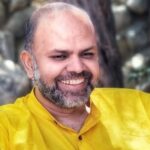 Anoop is a student of Yoga, an entrepreneur, a coach and a father of two young boys. He has led successful leadership stints in both the corporate and non-for-profit sectors. On encountering the country’s water/farmer crises at close quarters, he decided to pause and examine the impact various ‘isms’ – capitalism, colonialism, etc., were having on us as individuals, families, the society and the environment at large. This quest led him to formally engage with traditional Indic knowledge systems while also learning from the latest advances in science – about our physical and mental wellbeing, importance of body and mind work in healing trauma and the urgent need for a conscious rebuilding of family / work / social structures if we have to thrive individually and collectively. Insights, frameworks and processes gleaned from these on-going studies, an anchorage in his own personal practice and his wide-ranging experiences is what Anoop brings to facilitation/coaching spaces in Ritambhara and his various professional engagements.
 Priya is a Yoga therapist in the Krishnamacharya tradition. She adapts Reiki & energy work, Vedic chanting, life coaching & Ayurvedic practices in her healing spaces. She is committed to nurturing collectives that have the praxis of Yoga at their heart.
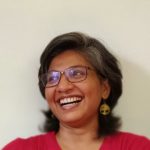 Anisha has been on an exploration to understand herself through yoga for the last 15years which led her to teaching yoga, yoga therapy and inner work through yoga.
 Apoorva chanced upon Yoga in her early 20s. A spark was lit within and there was no turning back. Her exploration led her to the Krishnamacharya tradition more than a decade ago. Curious about human behaviour and what drives it, she was thrilled when her search ended (and also began) when she first came upon the Yoga Sutra, which illuminated a path towards answering many questions that had been held for a long time.
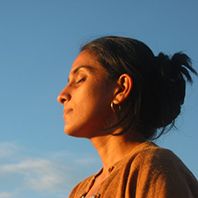 Anita is a yoga teacher and therapist in the tradition of Sri.T.Krishnamacarya and Sri T.K.V. Desikachar, a Reiki practitioner and a Life Coach. She is also the founder of Vishoka, a center for learning Indic and energy-based frameworks for living and healing. Her deep concern for human suffering and the problems of unsustainable living kept her on the path of seeking an integrated approach to looking at life, living, learning and healing.
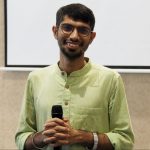 Ankit is a seeker in the wisdom traditions of India. The core of his work includes creating dialogic spaces where people can look within and see the connection between their inner and outer lives. Inspired by the likes of Gandhi, Aurobindo, Vivekananda and Guru Gobind his experiments in service took him back to his roots in Punjab where he is creating a community-led model of higher education which is open, inclusive and accessible for all. Ritambhara for him is a space for engaging in a community which is committed to a DHramic life. He anchors his work of learning and leadership in the Antaranga Yoga Sadhana and the humanistic wisdom of Mahabharata.